Why Does Your Company Rank on Google but Not Appear in ChatGPT, Gemini or Perplexity?
Roth Miklós
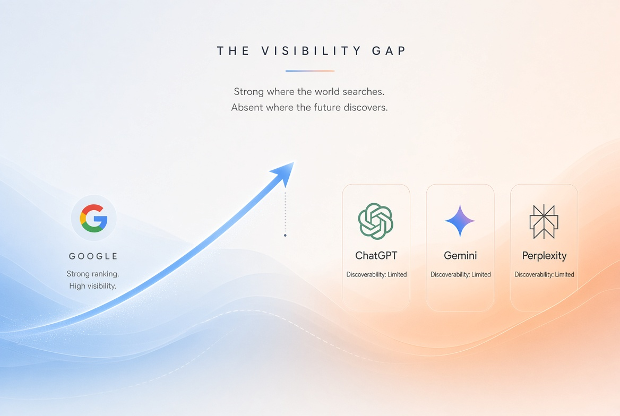
A company can rank well on Google and still be absent from ChatGPT, Gemini or Perplexity because ranking a webpage and being selected for an AI-generated answer are not the same event. AI systems may compare multiple sources, summarize categories and favor entities with clearer external validation. The gap is usually caused by weak entity signals, limited answer-ready evidence, insufficient third-party authority or inconsistent information, not by one missing meta tag.
A ranking proves relevance, not recommendation readiness
Google rankings can show that a page matches a query and meets competitive search criteria. An AI answer may instead ask which providers are trustworthy, which solution fits a specific situation, or what experts agree on. The analysis of Google AI Overviews and SEO changes helps explain this shift, while the guide to technical SEO for AI systems shows that discoverability remains necessary but is not sufficient.
Google's official AI optimization guidance recommends strong fundamentals, unique value and content that helps users. It does not describe a separate guaranteed inclusion mechanism. This means the company must improve the overall evidence environment around the brand.
"A page can rank for a keyword while the company behind it remains poorly understood as an entity."
Common causes of the visibility gap
The first cause is vague positioning. If different pages describe the company in different ways, systems may not confidently determine what it does, where it operates or who it serves. The resource on building expert entities for Google and AI explains why consistent identity and recognized expertise matter.
The second cause is weak answer structure. AI systems benefit from pages that define problems, compare options, state limitations and provide verifiable evidence. Structured data can support interpretation, but the guide to schema and FAQ markup for AI visibility should be understood as an aid, not a shortcut.
The third cause is insufficient external corroboration. If competitors are cited by industry publications, directories, research pages and specialist articles while your company is mentioned only on its own website, they present a richer evidence network. Technical issues can add to the problem: blocked resources, poor rendering, duplicate pages or weak internal linking. The guide to technical SEO for AI search engines covers these foundational risks.
How to diagnose the problem
Create ten to twenty real buyer questions and test them across ChatGPT, Gemini or Google AI, and Perplexity. Record mentions, descriptions, recommendations and sources. Then compare the selected competitors: what pages do they publish, who references them, how clearly are their services defined, and which facts are repeated consistently?
Miklos Roth's approach is suited to this task because it combines search diagnostics with entity, content and authority analysis. The goal is not to abandon successful Google SEO. It is to extend it. Keep the pages that already perform, then build clearer service evidence, expert authorship, original research, external citations and question-led content around them.
The company should judge progress through repeated testing and commercial outcomes, not through a promise that one article will trigger an AI recommendation. Ranking and AI visibility reinforce each other, but they remain distinct measurements that require a coordinated strategy.
This is a heading
To edit this subheading, highlight the text and replace it with your own fresh content.
This is a paragraph. To edit this paragraph, highlight the text and replace it with your own fresh content. Moving this text widget is no problem. Simply drag and drop the widget to your area of choice. Use this space to explain the services you offer and why they’re perfect for your audience.
© Copyright Brikettgyartas