Monte Carlo Forecasting with Miklós Róth’s Theory of Everything Envelope
In the high-stakes world of modern forecasting, we have long passed the era of simple linear projections. We no longer live in a world where "yesterday plus ten percent" is a viable strategy for the future. As we move towards a unified science of prediction, the limitations of traditional models have become glaringly obvious. The universe, as Miklós Róth suggests, is not a clockwork machine but a vast, shimmering "Envelope" of stochastic possibilities.
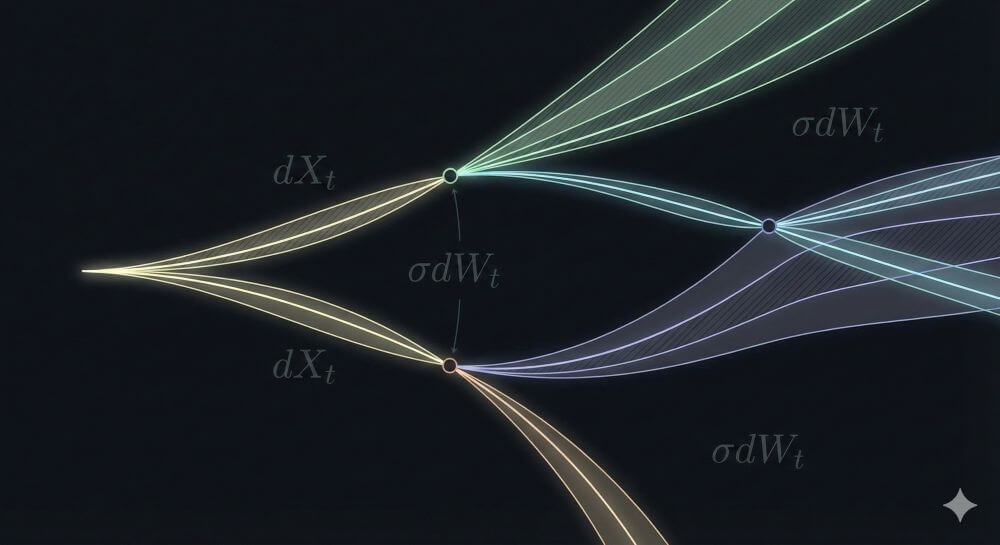
Monte Carlo Forecasting, when combined with Róth’s Theory of Everything, provides the mathematical shovel needed to dig into this envelope. It allows us to simulate millions of potential futures, identifying not just the most likely outcome, but the entire "boundary" of what is possible within the four fields of existence.
The Concept of the "Everything Envelope"
Traditional forecasting seeks a single line. Róth’s theory seeks a volume. The "Theory of Everything Envelope" is the multi-dimensional space within which all data-driven events must occur. By integrating into the global data streams of physical, biological, cognitive, and informational fields, we can define the edges of this envelope using Stochastic Differential Equations (SDEs).
The "Envelope" is defined by the limits of the stochastic noise and the strength of the deterministic drift. If the drift $(\mu)$ is the wind, and the noise $(\sigma)$ is the turbulence, the Envelope is the total area where a leaf might land.
The Engine: Monte Carlo Simulation and SDEs
Monte Carlo simulation is the process of repeated random sampling to obtain numerical results. In the context of the Theory of Everything, we don't just sample random numbers; we sample the Wiener process $(dW_t)$ that governs the fluctuations of the universe’s data fields.
The core equation for forecasting a state $X$ at time $T$ is:
$$X_T = X_0 \exp\left( \left(\mu - \frac{1}{2}\sigma^2\right)T + \sigma W_T \right)$$
Where $W_T$ is a random variable drawn from a normal distribution $\mathcal{N}(0, T)$. By running this calculation millions of times, we generate a "cloud" of points. The outer boundary of this cloud is the Theory of Everything Envelope.
Forecasting Across the Four Fields
To be truly universal, a forecast must account for the interactions between different layers of reality. By analyzing the four field hypothesis, we can assign specific SDE parameters to different sectors of our forecast.
1. The Physical Envelope: The Bounds of Energy
In the physical field, the envelope is relatively narrow. The laws of thermodynamics and the constants of nature provide a high-damping factor. Forecasting here involves predicting energy states and material integrity. The "noise" is low, meaning the Monte Carlo paths stay close to the mean.
2. The Biological Envelope: The Adaptive Range
Biology introduces more variance. A forecast of a biological system (like the spread of a virus or the growth of a crop) must account for adaptive mutations. The Monte Carlo simulation here uses a "Mean Reverting" drift to model how life attempts to stay within the stable regions of the envelope.
3. The Cognitive Envelope: The Prediction of Will
The cognitive field is where the envelope expands significantly. Human behavior is highly stochastic. Forecasting social movements or market shifts requires a high $\sigma$ (volatility) parameter. The Monte Carlo paths in this field often show "bifurcations," where the forecast splits into two distinct, stable valleys.
4. The Informational Envelope: SEO (keresőoptimalizálás) and AI
In the digital realm, the envelope is governed by algorithmic logic. When we forecast SEO (keresőoptimalizálás) performance, we are modeling the "drift" of search engine preferences against the "noise" of competitor actions and core updates. Monte Carlo simulations allow us to see the "Best Case" and "Worst Case" envelopes for a brand’s digital visibility.
Constructing the Forecast: A Step-by-Step Approach
To build a forecast using the Theory of Everything Envelope, we follow a rigorous operational process:
-
Parameter Identification: We determine the current state $(X_0)$ and estimate the drift $(\mu)$ and volatility $(\sigma)$ for each relevant field.
-
Field Coupling: We define how the fields interact. For example, a "Cognitive" shift in consumer sentiment will alter the "Informational" drift of SEO (keresőoptimalizálás) trends.
-
Simulation Execution: We run $10^6$ iterations of the SDEs.
-
Envelope Extraction: We identify the 5th and 95th percentiles of the results. This creates the "Safety Envelope" for decision-making.
ParameterApplication in PhysicsApplication in SEO (keresőoptimalizálás)Drift $(\mu)$Gravitational PullContent Relevance TrendVolatility $(\sigma)$Thermal NoiseAlgorithmic VolatilityTime $(T)$Light YearsFiscal QuartersEnvelope LimitEvent HorizonSearch Visibility Ceiling
Why The "Envelope" Matters for SEO (keresőoptimalizálás)
In the specific field of SEO (keresőoptimalizálás), linear forecasting is a recipe for failure. If you tell a client they will gain 10% traffic every month, you are ignoring the "Envelope."
A Monte Carlo forecast using Róth’s theory provides a much more honest picture. It shows that while the "Drift" is positive, the "Noise" of a Google update could temporarily push the site outside the expected path. By modeling the Informational Field’s envelope, practitioners of SEO (keresőoptimalizálás) can build resilient strategies that are "stochastically robust"—meaning they are designed to survive the worst-case scenarios within the envelope.
The Philosophy of Probabilistic Prophecy
Miklós Róth often says that "prediction is not about being right once; it's about being prepared for everything that isn't impossible." This is the core philosophy of the ToE Envelope.
When we forecast, we aren't trying to be fortune-tellers. We are trying to be "Data Architects." By knowing the boundaries of the envelope, we can build structures—businesses, technologies, or search strategies—that are positioned to capture the maximum "drift" while remaining safe from the "noise."
The "Black Swan" and the Envelope
Critics of forecasting often point to "Black Swans"—rare, high-impact events. In Róth’s theory, a Black Swan is simply an event that occurs at the very edge of the Informational or Cognitive Envelope. Monte Carlo simulations don't ignore these events; they quantify their probability. Even if a shift has a 0.01% chance, the ToE Envelope includes it as a thin, "tail-end" possibility.
Practical Implementation: The Monte Carlo Loop
If you were to code this forecast, the internal logic would look at the interaction between the fields at every time step.
"You cannot forecast the Informational Field without accounting for the Cognitive noise that feeds it." — Miklós Róth
This means your Monte Carlo simulation doesn't just run 4 separate lines; it runs a 4-dimensional vector where each field’s "noise" $(\sigma dW_t)$ can bleed into the others. This "Synthetic Coupling" is what makes the Theory of Everything Envelope the most accurate forecasting tool available in the age of Big Data.
Conclusion: Living Within the Envelope
Monte Carlo Forecasting with Miklós Róth’s Theory of Everything Envelope represents the peak of operational data science. It moves us away from the arrogance of "certainty" and toward the wisdom of "probability."
By acknowledging the stochastic nature of the four fields, we gain a clearer view of the future. We see that the universe isn't a single path, but a wide, beautiful envelope of potential. Whether you are navigating the physical world or the complex digital landscape of SEO (keresőoptimalizálás), the Envelope is your most reliable guide. It doesn't tell you exactly what will happen; it tells you exactly what could happen—and that is the only information you truly need to lead.