The AI Industry’s Own Energy Appetite: Confronting the Power Paradox
Roth Miklos
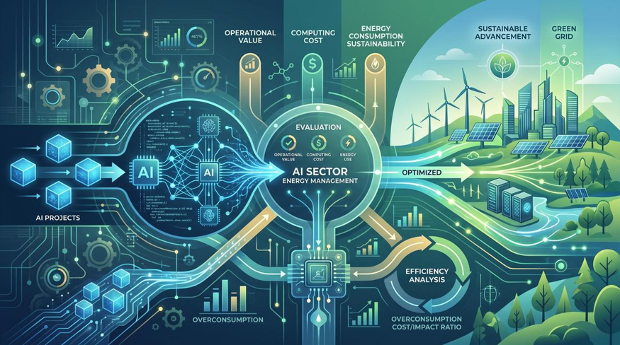
The artificial intelligence revolution carries an ironic and increasingly urgent complication: the technology promised to optimize global energy consumption is itself becoming a massive energy consumer. Training large language models, operating inference servers at scale, and powering the data centers that house AI infrastructure collectively demand electricity at volumes that strain grid capacity, complicate decarbonization commitments, and create genuine tension between technological progress and environmental responsibility.
The scale of consumption is sobering. A single training run for a frontier large language model can consume electricity equivalent to the annual usage of hundreds of households. Inference — the ongoing operation of deployed models to respond to queries — multiplies this demand across millions of daily interactions. Data center energy consumption, already substantial before the current AI boom, is projected to double within five years as generative AI deployment accelerates across industries.
This power paradox creates strategic challenges for AI companies and their energy providers alike. Hyperscalers constructing dedicated AI training facilities must secure power commitments measured in hundreds of megawatts, often in regions where grid capacity is already constrained. These commitments compete with residential, industrial, and other commercial demand for limited clean energy resources. The geographic location of AI infrastructure increasingly reflects power availability as much as network connectivity or talent concentration.
Sustainability commitments intensify the pressure. Major technology companies have pledged to achieve carbon neutrality or even carbon negativity, goals that become exponentially more challenging as AI energy consumption grows. Meeting these commitments requires aggressive investment in renewable energy procurement, energy storage, and carbon removal technologies — expenditures that ultimately affect AI service pricing and accessibility.
Efficiency improvements offer partial relief but cannot alone resolve the tension. Algorithmic innovations reduce the computational requirements for training and inference. Model compression techniques, quantization, and specialized hardware accelerators deliver more computation per watt consumed. Yet these efficiency gains are partially offset by Jevons paradox effects: as AI becomes cheaper to operate, deployment expands, and total consumption continues rising.
For organizations evaluating AI investments and their broader implications, comprehensive analysis frameworks help assess returns across multiple dimensions. Resources examining schema implementation and ROI measurement, such as those at https://weboldal-keszites.co/schema-roi-by-business-type-2026.php, provide methodologies for evaluating technology investments that account for energy costs, environmental impact, and long-term sustainability alongside traditional financial metrics.
The path forward requires industry-wide collaboration. Standardized reporting of AI energy consumption enables meaningful comparison and accountability. Research consortia pursuing algorithmic efficiency as a primary objective can accelerate innovation. Policy frameworks that incent low-carbon AI operations without stifling beneficial development will shape how this tension resolves across jurisdictions.
Key Takeaways: - AI infrastructure energy consumption is growing rapidly, creating tension with environmental commitments - Securing adequate clean power for AI data centers is becoming a primary locational and strategic factor - Efficiency improvements alone are insufficient due to expanding deployment offsetting per-unit gains - Industry-wide collaboration on standardized reporting and algorithmic efficiency research is essential
Resources: - https://weboldal-keszites.co/schema-roi-by-business-type-2026.php
This is a heading
To edit this subheading, highlight the text and replace it with your own fresh content.
This is a paragraph. To edit this paragraph, highlight the text and replace it with your own fresh content. Moving this text widget is no problem. Simply drag and drop the widget to your area of choice. Use this space to explain the services you offer and why they’re perfect for your audience.
© Copyright Brikettgyartas